

Commentary: Big Tent Ideas
CHAD ENNIS: Supreme Court Can Restore Fair Court Access For Conservative Election Challenges
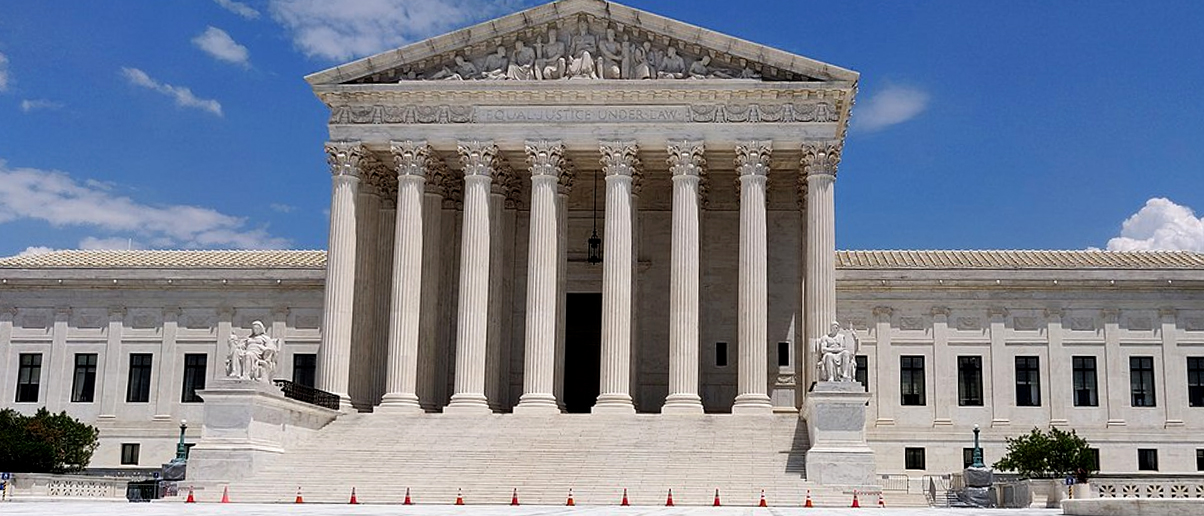
Wikimedia Commons
This week the Supreme Court is set to hear Bost v. Illinois State Board of Elections. The case is about access to courts.
For too long, courts have opened their doors to left-wing groups filing frivolous lawsuits to election integrity laws but denied meaningful challenges from conservatives. Bost can correct this.
Michael Bost is a Congressman from Illinois. He challenged an Illinois law that allowed mail ballots to be received and counted up to 14 days after Election Day. He argued that by extending the receipt of mail ballots beyond Election Day, the Illinois law conflicted with federal law that sets Election Day as the first Tuesday after the first Monday in November.
The lower courts dodged answering this question by finding that Bost did not have standing to challenge the law because Bost was not harmed by it. Bost was, therefore, tossed out of court before he could even make his case.
Exactly 89% of Americans agree that allowing mail ballots to come in a full two weeks after the election is bad policy. The slow trickle of arriving ballots kills confidence in elections. Watching daily vote changes for two weeks after election day is detrimental to how the public views the election. As margins shrink and vote leaders change, confidence sinks. As days go by and no winner is declared, confidence further sinks.
These long ballot acceptance periods need to go. The Fifth Circuit Court of Appeals has found that accepting mail ballots that arrive after Election Day violates federal law. And President Trump’s Executive Order on Elections seeks to enforce those same laws by eliminating these periods in Federal elections.
The Seventh Circuit, however, closed the courthouse door on Bost and would not allow him to make his case. They ruled he did not provide enough evidence that he was harmed by the Illinois law.
Of course, there are many ways Bost is harmed by the Illinois rule. First, the rule imposes a financial impact on candidates. Instead of paying lawyers to monitor the counting of ballots on a single election night, Bost must fund the lawyers for two weeks of counting. Second, the rule makes get-out-the-vote efforts longer and more expensive. These costs are imposed on candidates by Illinois law and inflict harm that should allow Bost to at least get into court. But the Seventh Circuit said no.
This contrasts with the Fifth Circuit. That court allowed the Republican National Committee to challenge a similar Mississippi statute. Candidate Bost shares the same — or perhaps even a greater — level of interest in the administration of an election as a political party.
The Left loves the Seventh Circuit’s holding. That may seem counterintuitive. The Left often challenges election laws. The reason they love the Bost case has everything to do with the type of case it is versus the type of cases the Left brings. Almost without fail, the Left brings cases based upon fringe, “woke” theories. Insert your favorite “marginalized” group, and the Left has brought a case on their behalf claiming that things as basic as showing ID or needing to register to vote constitute “suppression.”
Their cases are brought under the Voting Rights Act, the Civil Rights Act, or the First Amendment. They will fight tooth and nail to preserve their own access to the courts.
But lawsuits from the right are vastly different, and liberals are perfectly happy to close the courthouse doors to them. In the Left’s view of elections, the only harms are discrimination. Being forced to waste money and eroding faith in elections are not harmful to them. If their favored election laws are unchallengeable in court, so much the better. Conservatives have historically struggled far more than the left to get into court, and rulings like Bost promise to keep it that way.
The Supreme Court must recognize harm caused by extended mail ballot deadlines and grant Bost standing to challenge Illinois law. The financial strain on candidates, the prolonged uncertainty of election outcomes, and the erosion of public confidence are not abstract concerns—they are tangible consequences that undermine the integrity of our electoral process.
If political parties are permitted to challenge such laws, candidates should be afforded the same right. The Seventh Circuit’s refusal to acknowledge this harm sets a dangerous precedent, one that shields flawed election policies from scrutiny. Upholding Bost’s standing would not only restore fairness but also reaffirm the principle that election laws must serve voters and candidates — not partisan advantage.
Chad Ennis is the Vice President of the Honest Elections Project.
The views and opinions expressed in this commentary are those of the author and do not reflect the official position of the Daily Caller News Foundation.
(Featured Image Media Credit: Public Domain via Wikimedia Commons)
All content created by the Daily Caller News Foundation, an independent and nonpartisan newswire service, is available without charge to any legitimate news publisher that can provide a large audience. All republished articles must include our logo, our reporter’s byline and their DCNF affiliation. For any questions about our guidelines or partnering with us, please contact [email protected].