

Legal/Law/Criminal Justice and Reform
Supreme Court Could Be Final Arbiter As Lower Courts Unilaterally Derail Trump DOJ Appointees
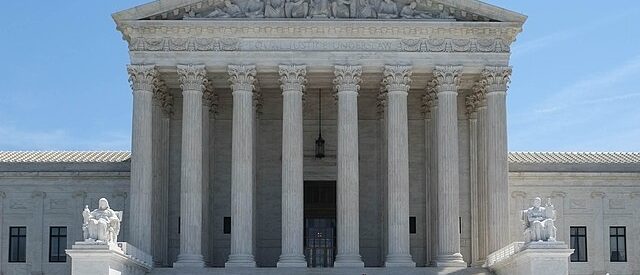
Wikimedia Commons/Paul Sableman
Lower courts attempting to keep the president’s preferred U.S. attorneys out of office might have sparked a major legal battle.
As Democratic home state senators hold up confirmation for President Donald Trump’s U.S. attorney nominees, the administration is employing unusual methods to extend the terms of his temporary picks and prevent district court judges from unilaterally appointing their own choices under a little-used federal law.
“It seems constitutionally odd to have members of Article III appointing Article II officials,” Ilya Shapiro, director of Constitutional Studies at the Manhattan Institute, told the Daily Caller News Foundation. “I could see this issue making it to the Supreme Court in the context of a criminal defendant challenging the propriety of his prosecution.”
When Alina Habba’s 120-day appointment as New Jersey’s interim U.S. attorney expired in July, New Jersey district court judges selected her deputy, Desiree Leigh Grace, to fill the role.
However, Bondi fired Grace hours after the mostly Democrat-appointed judges selected her. She reinstated Habba by withdrawing her pending nomination and making her acting U.S. attorney.
Democratic New Jersey Sens. Andy Kim and Cory Booker claimed the court used a “rightful exercise of authority” to appoint Grace. Both previously opposed Habba for engaging in “politically motivated prosecutions.”
Habba previously served as Trump’s personal attorney in the E. Jean Carroll defamation case.
“I don’t cower to pressure,” Habba wrote July 24 on X. “I don’t answer to politics.”
Bondi’s decision threw courts into confusion as some proceedings in the district were canceled due to uncertainty over Habba’s status, The New York Times reported.
One attorney, whose client was set to go to trial on drug charges Aug. 4, filed a motion July 27 challenging Habba’s authority. Chief U.S. District Judge Matthew Brann of the Middle District of Pennsylvania scheduled oral arguments for August 15 to consider his request to prevent Habba from prosecuting the case.
“The Government’s position has extreme implications that it openly embraces: by using the Special Attorney designation and delegation, Ms. Habba may exercise all of the powers of the United States Attorney without being subject to any of the statutory limitations on that office,” Brann wrote.
The DOJ defended Habba’s position in a filing Tuesday.
“Whether or not Ms. Habba technically qualifies as Acting United States Attorney, the Attorney General has validly delegated to her the authority to supervise all pending prosecutions and other matters in the USAO-NJ, subject in turn to the supervision by the Attorney General and Deputy Attorney General, both of whom are Senate-confirmed,” the DOJ’s filing states.
Donald J. Trump is the 47th President.
Pam Bondi is the Attorney General.
And I am now the Acting United States Attorney for the District of New Jersey.
I don’t cower to pressure. I don’t answer to politics.
This is a fight for justice. And I’m all in. 🇺🇸
— US Attorney Habba (@USAttyHabba) July 24, 2025
Rutgers Law professor Thea Johnson told NJ Advance Media the issue could end up before the Supreme Court.
“You can’t just have an indefinite pause in criminal cases,” Johnson told the outlet on Tuesday.
Trump made a similar move in the Northern District of New York, where federal district judges declined to make John A. Sarcone III’s appointment as U.S. attorney permanent in July. Sarcone was named “special attorney to the attorney general” and granted the powers of acting U.S. attorney.
In Los Angeles and Nevada, outgoing interim U.S. attorneys Bilal A. Essayli and Sigal Chattah have also been designated as acting U.S. attorneys, extending their terms for 210 days.
“Donald Trump knows Sigal Chattah would be soundly rejected by both sides of the aisle if she had to be confirmed by the U.S. Senate, which is why he’s relying on an unconstitutional maneuver to keep her in this role indefinitely,” Democratic Nevada Sen. Jacky Rosen wrote Tuesday on X. “This is an outrageous move, and I call on the legal system to immediately remove her.”
Chattah was previously Nevada’s Republican national committeewoman and came under fire for comments she made while running for Nevada Attorney General.
Lower courts have thrown up major roadblocks to Trump’s agenda since January, though they have frequently been reversed by the Supreme Court on appeal.
In June, the Supreme Court reined in lower courts’ ability to issue universal injunctions that block policies nationwide, which lower courts used to prevent enforcement of Trump’s executive order on birthright citizenship. The Supreme Court gave Trump the greenlight to fire executive officials after lower courts attempted to keep them in place while litigation is pending.
‘Exercise Of Executive Power’
Northwestern University law professor Steve Calabresi argued the statute allowing district courts to select a U.S. attorney when an interim appointment expires, which has been on the books since the Civil War, is unconstitutional.
“The office of Interim U.S. Attorney is not quasi-judicial, or quasi-legislative,” he wrote on The Volokh Conspiracy blog. “It involves solely the exercise of executive power. This means that only the Attorney General can appoint Interim U.S. Attorneys, and the President or Attorney General can and should on principle fire any Interim U.S. Attorney appointed by federal district judges.”
The Supreme Court has not yet weighed in on “cross-branch Appointment of inferior officers like Interim U.S. Attorneys,” he wrote.
However, University of California at Berkeley law professor John Yoo told the DCNF the statute is constitutional.
“The Constitution’s appointments clause allows the courts to appoint certain categories of officials, even within the executive branch,” he said,
University of Utah law professor Paul Cassell likewise wrote the statute is constitutional but argued that the attorney general still broadly has authority to select temporary U.S. attorneys.
“Ms. Habba is lawfully the acting U.S. Attorney in the District of New Jersey, at least for a short period of time, via the somewhat circuitous route of having been appointed by the Attorney General to be the First Assistant in the Office, and then being elevated to the Acting U.S. Attorney via the Federal Vacancies Reform Act (FVRA),” he wrote.
“But one problem with this approach is that, while seemingly authorized by statute, it appears to have the potential to deprive the Senate of its opportunity to vote on the U.S. Attorney selection for a lengthy period of time,” he continued. “Rather than relying on the FVRA, a more straightforward path for the Attorney General is to simply appoint an ‘interim’ U.S. Attorney every 120 days, under § 546—while the President simultaneously nominates that person to be the permanent U.S. Attorney.”
The U.S. attorney’s offices for the Central District of California and for the District of Nevada declined to comment.
All content created by the Daily Caller News Foundation, an independent and nonpartisan newswire service, is available without charge to any legitimate news publisher that can provide a large audience. All republished articles must include our logo, our reporter’s byline and their DCNF affiliation. For any questions about our guidelines or partnering with us, please contact [email protected].